
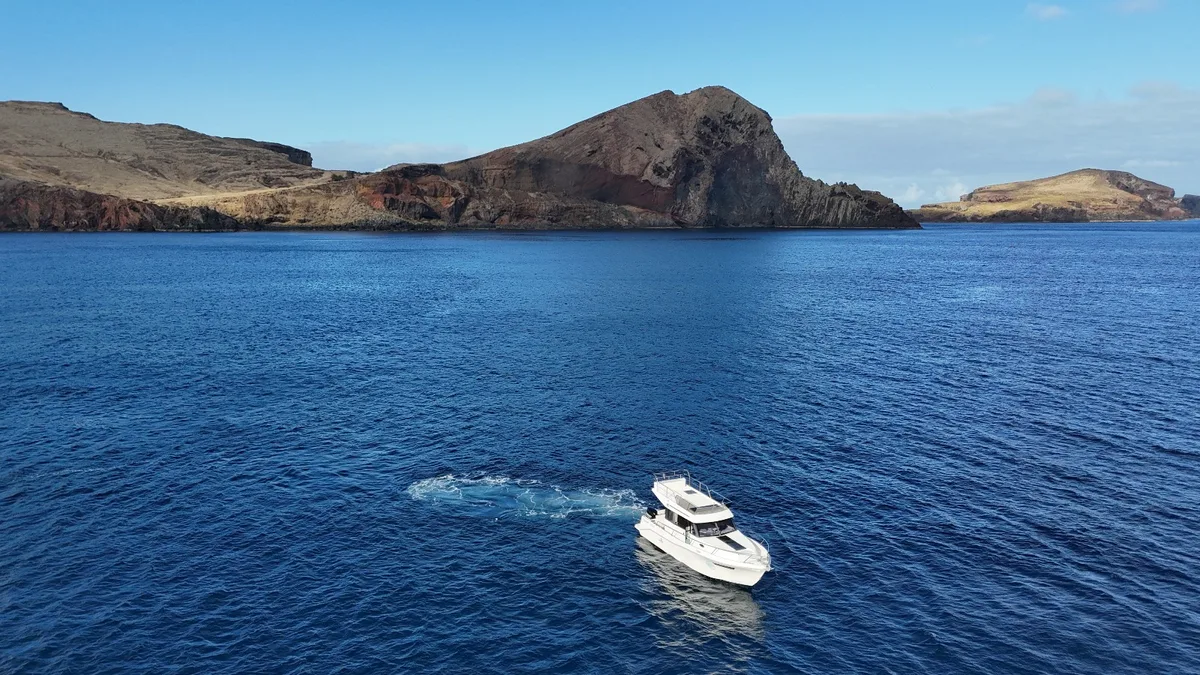
Madeira’s steep underwater canyons drop close to shore, concentrating nutrients and wildlife in accessible waters. Twenty-six cetacean species have been recorded in the archipelago, including resident bottlenose dolphins and short‑finned pilot whales, with pelagic visitors adding variety across the seasons [1]. Such richness requires restraint. Encounters should be set by animal welfare rather than the pursuit of close‑ups.
Responsible whale watching is both a mindset and a method. The ocean is wildlife’s home. Our presence should not cause stress, force course changes, split mother–calf pairs or disrupt feeding. Whether you join a shared tour or charter a private yacht, knowing Madeira’s rules and on‑board etiquette helps you turn a day at sea into support for conservation and sustainable tourism.
This guide outlines Madeira’s legal framework for observing marine vertebrates, what those rules achieve, how to identify ethical operators and how to behave on board to minimise disturbance. It also separates public facts set by regulation from skipper decisions made in real time—so you can set realistic expectations and enjoy calmer, more authentic encounters.
The Importance of Ethical Marine Observation
Respectful approaches protect animals and enhance guest experiences. Cetaceans rely on sound to communicate, navigate and hunt; loud engines, abrupt manoeuvres or crowding can confuse them, trigger avoidance and separate calves from mothers. Repeated disturbance wastes energy needed for feeding, migration and reproduction. Keeping distance and reducing noise allows natural behaviour and lets animals choose if they remain near a slow, predictable vessel.
For guests, that means unforced moments rather than staged chases. Calm boats and short, measured encounters reduce stress for animals and people, while preserving the very asset that underpins Madeira’s ocean‑based tourism. Your choices—operator, conduct and expectations—help keep this balance viable.
Madeira’s Cetaceans and Why the Island Matters
Madeira’s position in the North Atlantic and its dramatic bathymetry provide habitat for deep divers and coastal residents. Bottlenose dolphins often work nearshore reefs, while short‑finned pilot whales favour the deeper slopes that fall away rapidly from the coastline [1]. With 26 recorded cetacean species in the archipelago, variety is part of the appeal for guests and researchers alike [1].
High wildlife density can attract multiple boats. Without rules, animals risk being surrounded or repeatedly intercepted. Madeira addresses this through specific legislation and active oversight to keep encounters orderly, respectful and safe for wildlife and guests [2][3].
The Legal Framework: What the Rules Say
Marine vertebrate observation in Madeira is regulated by Regional Legislative Decree No. 15/2013/M, which sets approach distances, vessel speed, approach angles and time limits with a group [2]. Oversight is carried out by the Institute for Forests and Nature Conservation (IFCN), which supervises the activity and issues guidance to operators [3]. Public facts you can rely on include:
- Minimum approach distances and time limits are defined by law [2][3].
- Vessel speed must be reduced progressively and must not exceed the animals’ speed [2][3].
- Approaches must preserve a clear escape route; head‑on, directly from behind or perpendicular approaches are prohibited; the vessel should run parallel, settling slightly abaft the animals’ movement [2].
- Swimming with whales is strictly prohibited [2].
The framework aligns tourism with animal welfare and creates predictable conditions for ethical encounters.
Safe Distances, Speed, and Time Limits
Distance is the first layer of protection. Vessels must keep at least 50 metres from whales and dolphins, and 25 metres from marine turtles [2][3]. These buffers lower collision risk and help reduce acoustic disturbance, protecting communication and echolocation.
Speed and approach shape how animals perceive a boat. As a vessel enters an observation zone, skippers must slow progressively and keep speed at or below the animals’ pace [2][3]. Sudden acceleration, hard braking or sharp turns startle wildlife and are discouraged. Boats should position themselves on a parallel track and settle slightly to the rear quarter, leaving a clear path if animals choose to move away. Approaching head‑on, directly from behind or perpendicularly is prohibited [2]. Expect measured handling rather than dramatic sprints.
Time Limits and Conduct at Sea
To reduce cumulative pressure, the maximum observation time per vessel with any one group is 10 minutes [3]. If several boats arrive, responsible skippers coordinate informally—often by radio—to avoid surrounding animals or forming queues. Rotation and restraint are the goals: offer a respectful view, then move on so wildlife can feed, rest or socialise with minimal disturbance [4].
Good conduct goes beyond steering. Crews may reduce engine noise where practical, avoid cutting across the path of travelling animals and take extra care around calves. If wildlife shows avoidance—extended dives, abrupt changes of direction or increased speed—ethical operators end the interaction early. These choices honour both the letter and the spirit of Madeira’s regulations [3][4].
Choosing Operators and On-board Etiquette
Your booking decision is the strongest lever you have. Before confirming, ask clear, practical questions:
- Do they apply Madeira’s legal distances, time limits, speed reductions and approach angles [2][3]?
- How do they handle situations with multiple vessels present?
- Will they brief guests on behaviour that reduces disturbance?
- Do they collaborate with researchers, share sightings data or follow IFCN guidance [3]?
Responsible operators are transparent about the law, do not guarantee sightings and prioritise animal welfare over close‑ups. They also set honest expectations about sea conditions and routes as variables shaped by the day. Clear communication signals they will place safety and welfare ahead of photo opportunities.
Skippers implement the rules; guests help make them work. Simple habits matter:
- Keep voices low and movements calm; sudden noise can prompt avoidance.
- Follow crew instructions promptly, especially when yielding to other vessels or repositioning.
- Do not feed, touch or throw objects near wildlife.
- Secure loose items to prevent litter entering the water.
- Use binoculars or zoom lenses rather than leaning out for a closer look.
These actions help crews maintain smooth, predictable handling—one of the best ways to foster natural behaviour within the permitted timeframe.
Public Facts vs Operational Decisions
A smooth day depends on understanding what is guaranteed by regulation and what varies with conditions and skipper judgement.
Public facts:
- Observation is regulated by Regional Legislative Decree No. 15/2013/M [2].
- IFCN monitors and enforces the activity [3].
- Minimum distances: 50 metres for whales and dolphins; 25 metres for marine turtles [2][3].
- Approaches must be parallel and set slightly abaft the animals’ movement; head‑on, direct rear and perpendicular approaches are prohibited [2].
- Vessel speed must be reduced gradually and not exceed the animals’ speed [2][3].
- Maximum observation time per vessel with a group is 10 minutes [3].
- Swimming with whales is illegal in Madeira [2].
Operational decisions and variables:
- Sightings are never guaranteed; they depend on weather, sea state and animal movements.
- Routes and pace are determined by the skipper in response to conditions on the day.
- The captain may end an encounter before 10 minutes if animals show disturbance or if calves are present.
- If several boats converge, skippers may rotate or leave to prevent crowding [4].
- Tours may be altered or cancelled if conditions are unsuitable for safe navigation or responsible observation.
Knowing this distinction keeps expectations realistic and gives crews the latitude to act in the animals’ best interests.
Setting Expectations at Sea
Whale watching is not a scripted show. Some days bring pilot whales cruising alongside; others yield brief dorsal fins at distance. Dress for changing conditions, secure sun protection and be ready for a moving platform. If you’re prone to seasickness or have concerns, consider consulting a healthcare professional or pharmacist in advance for personal guidance. On board, fresh air, watching the horizon and avoiding screens can help you feel steadier.
The most meaningful success metric is not proximity but whether your presence left behaviour unchanged and your skipper followed the law. Returning to shore knowing the encounter was respectful and compliant helps keep Madeira’s wildlife experiences sustainable for the next guest—and, more importantly, for the animals themselves.
Sources
This guide uses the following official or specialist references. Confirm time-sensitive details at source before making travel plans.
Practical answers before you travel.
Why is there a time limit on encounters?
Madeira caps each vessel’s time with a group at 10 minutes to reduce cumulative stress and avoid crowding. Short, well‑managed observations let wildlife feed, rest and socialise with minimal disruption while still offering a respectful view [3][4].
Why can’t the boat get closer to whales or dolphins?
Minimum distances—50 metres for cetaceans and 25 metres for marine turtles—are legal safeguards. They reduce collision risk, limit acoustic disturbance that affects communication and navigation, and discourage behaviour changes triggered by close approaches [2][3].
How should operators approach animals to avoid stress?
Skippers slow gradually, avoid abrupt manoeuvres and run the boat parallel, settling slightly to the rear quarter—never head‑on, directly from behind or perpendicularly. They keep speed at or below the animals’ pace and end early if avoidance is shown or calves are present [2][3].
Can you guarantee sightings or promise a fixed route?
No. Wildlife movements, sea conditions and weather vary. Ethical operators avoid guarantees and keep itineraries flexible; skippers adjust plans on the day to balance guest experience with responsible practice and safety.
What happens when several boats arrive at the same group?
Operators coordinate informally to prevent surrounding animals. Each vessel is limited to 10 minutes and should move on after a respectful observation. If animals appear disturbed, ethical skippers leave sooner and seek calmer opportunities elsewhere [3][4].
Can I swim with whales in Madeira?
No. Swimming with whales is strictly prohibited by law in Madeira. Close in‑water approaches can disturb animals and pose safety risks; the ban protects wildlife and guests while keeping encounters non‑invasive and controlled [2].