
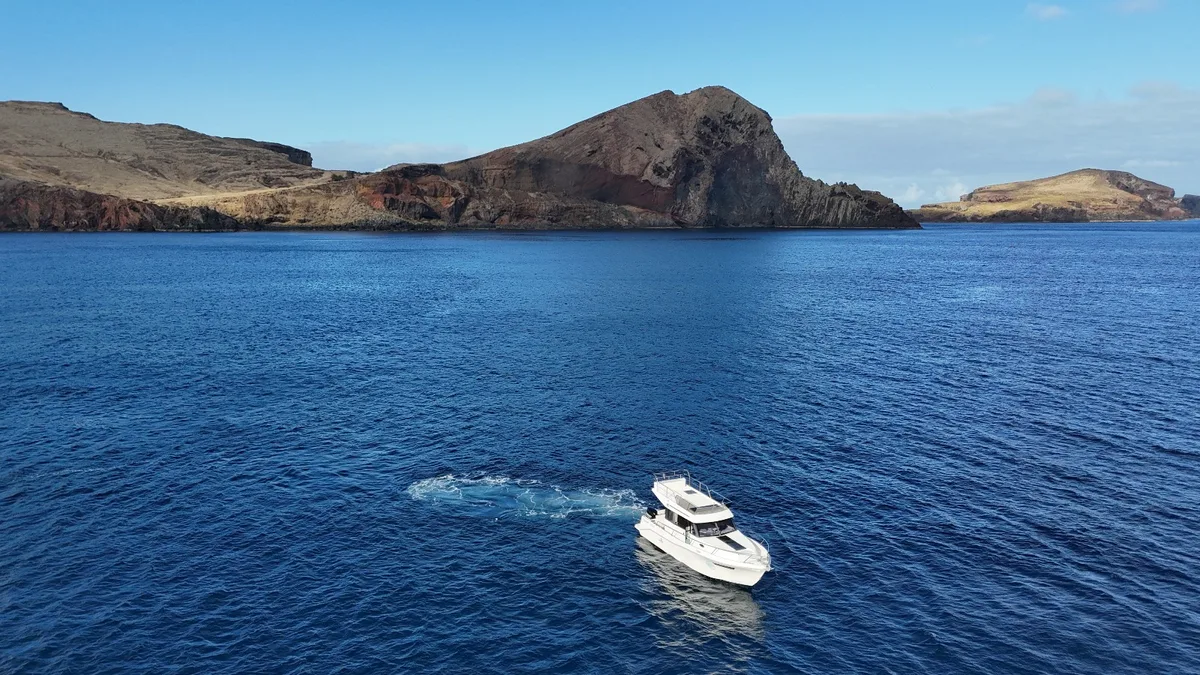
Deciding how long to hire a private yacht in Madeira shapes the whole trip. A shorter outing offers a concentrated taste of the coast; a full day opens up more options, more stops and a longer window for sea life to appear. Each choice has trade-offs linked to group makeup, tolerance for time at sea and the sort of memories you want to come home with.
Madeira’s main marine gateway is the Marina do Funchal, which holds around 200 berths and is a common departure point for private charters and day trips [1]. Weather forecasts and sea bulletins are published regularly by the national meteorological service; operators use these to plan safe departures and adaptable routes [3]. Knowing the local rules for approaching wildlife and protected areas will also help you pick the charter length that best fits your priorities.
The half-day yacht charter experience
A half-day charter typically lasts three to four hours and suits visitors who want a focused maritime experience without committing an entire day. Mornings are popular for calm seas and clear light; late afternoons are chosen for sunsets and cooler temperatures. With limited time, skippers usually concentrate on a single coastal sector so you can enjoy sightseeing, a short swim and perhaps a bit of snorkelling.
The strengths of the half-day are simplicity and predictability. It is easier to fit into a busy holiday schedule, gentler on small children and a solid option if you only want to tick “boat trip” off a list. Because the vessel remains within a restricted area, transfer times and fuel consumption are lower, which some operators reflect in their offerings.
On the flip side, a shorter charter narrows the area that can be covered and reduces the chance window for encountering marine mammals or remote coves. Skippers will always pick the safest, most interesting route for the conditions on the day, but a half-day limits flexibility compared with a full-day outing.
The full-day yacht charter experience
A full-day charter commonly spans seven to eight hours and is aimed at guests who want a relaxed, exploratory day at sea. With more hours available the skipper can visit more distant coves, change course to avoid rougher patches and allow longer stops for swimming, snorkelling or simply lounging on deck.
A full day allows for a more leisurely rhythm: breakfast or an extended picnic aboard, multiple swim stops and the time to head to quieter stretches of coast. For groups keen to explore protected marine sites or to move between several scenic anchorages, a full-day hire offers the opportunity to make the most of the island’s varied coastline without the rush.
The downside is that a longer day requires greater stamina from passengers and more detailed provisioning. If anyone in the party is prone to seasickness, or if you have very young children, plan carefully and discuss options with the operator before booking.
Marine life encounters: patience and regulation
Encounters with dolphins, whales and turtles are a major reason many guests choose a charter, but sightings are never guaranteed — these are wild animals in their own environment. A full-day charter increases the amount of time you are on the water and therefore the chance of spotting marine life, but it does not create certainty.
Crucially, Madeira operates a clear legal framework for the observation of marine vertebrates. Vessels must reduce speed to below 12 knots when within 500 metres and to less than 8 knots when closer to 300 metres; a safe approach distance of 50 metres applies to cetaceans and 25 metres to sea turtles. Observation time near a single group of animals is restricted to 10 minutes per vessel to avoid disturbance [2]. Skippers are responsible for complying with these rules and will always prioritise the animals’ welfare over passenger expectations.
Navigating protected areas
Madeira and its surrounding islets include several marine protected areas. These zones have specific rules on anchoring, motorised navigation and access; some require prior permits or are off-limits to landing. For instance, the Santana Biosphere Reserve recognised by UNESCO includes an adjacent marine area that extends to the 200-metre isobath, which is relevant for planning routes near that region [4]. Other local reserves such as Garajau have their own restrictions on motorised entry and activities.
A full-day charter gives more room to work around protected boundaries and to reach permitted viewing points without feeling constrained by time. Whatever the duration you choose, the skipper will advise where you can safely anchor and where activities such as snorkelling are permissible.
Practical planning: what to pack and who should come
Think practically about the passengers: energetic snorkellers and older children may thrive on a full-day trip, while elderly guests or toddlers will often prefer a half-day. Both trip lengths benefit from sensible preparation: layered clothing for changing coastal microclimates, reef-safe sunscreen, a hat and footwear with good grip.
Operators differ in what they include—some provide snacks, soft drinks and snorkelling gear, others offer fully catered lunches on full-day packages. Confirm inclusions and passenger limits with the company before you book. If anyone in your party experiences seasickness, consult a healthcare professional for personalised advice rather than relying on online prescriptions or unverified remedies.
Public facts versus skipper and operator decisions
It helps to separate facts controlled by public authorities from choices made by the skipper or company.
Public facts:
- The Marina do Funchal’s approximate capacity and role as a departure hub are established by port authorities [1].
- The rules on approach distances, speed reduction and observation time for marine animals are set by regional conservation law and enforced locally [2].
- Weather and sea-state bulletins are produced by the national meteorological institute and used to inform safe operation [3].
- Recognised protected areas and their bathymetric extents, like the Santana Biosphere Reserve to the 200 m isobath, are public information [4].
Operational decisions:
- Exact itinerary, timing of stops and which bays to visit are chosen by the skipper on the day to match safety and passenger requests.
- What is provided aboard—meals, drinks, snorkel equipment, towels—varies by operator and by the charter package.
- Pricing, cancellation policies and maximum passenger numbers are set by the charter company and may change with season.
Distinguishing these helps set realistic expectations: rely on public facts for safety and legal matters, and on the operator for hospitality details.
Choosing duration: a simple decision guide
To decide which length suits you, weigh these practical points:
- Time available on land: if you have only a few hours free, a half-day is efficient.
- Group stamina and age range: younger children and older adults usually do better on shorter trips.
- Interest in exploration: if you want to visit multiple coves or protected sites, a full day gives the flexibility to do that.
- Appetite for wildlife: a full-day widens the search window for animals, though sightings remain unpredictable.
- Comfort with being at sea: if anyone is uncertain, discuss shorter-duration options with the operator and check daily weather briefings.
Choose the duration that aligns with your party’s comfort and the kind of memory you want to prioritise — a refreshing coastal spin or a slow, exploratory day at sea.
Sources
This guide uses the following official or specialist references. Confirm time-sensitive details at source before making travel plans.
Practical answers before you travel.
Is it worth booking a full-day charter if we mainly want to see dolphins?
A full day gives a longer window to search for dolphins and other marine life, but animal sightings cannot be guaranteed. Operators often have land-based lookouts and experience that improve chances, yet the presence of wildlife depends on nature.
Can the skipper change the itinerary on the day?
Yes. The skipper is responsible for safety and will alter routes if the sea state, wind or animal behaviour suggests a change is better for comfort and welfare. Treat your itinerary as a plan that may be adapted.
Are there limits on how close we can get to whales or turtles?
Yes. Regional rules set minimum approach distances—50 metres for cetaceans and 25 metres for turtles—and specify speed reductions and short observation windows to protect the animals [2]. Your skipper will enforce these limits.
Will we be able to swim from the yacht?
Swimming and snorkelling are common on charters, but not in immediate proximity to protected species. Some marine reserves limit motorised access and anchoring, so the skipper will suggest permitted spots where swimming is allowed and safe.
What if someone gets seasick during a full-day charter?
Seasickness can happen on any trip. Operators advise practical measures such as staying on deck, looking at the horizon and keeping hydrated. For medical treatments or prescription options, consult a healthcare professional before travel rather than seeking specific medical advice from the charter company.
How far in advance should we book?
Booking lead times vary with season and vessel type. Popular dates, weekends and holidays book earlier. Contact your chosen operator to confirm availability rather than relying on an assumed reservation window.