
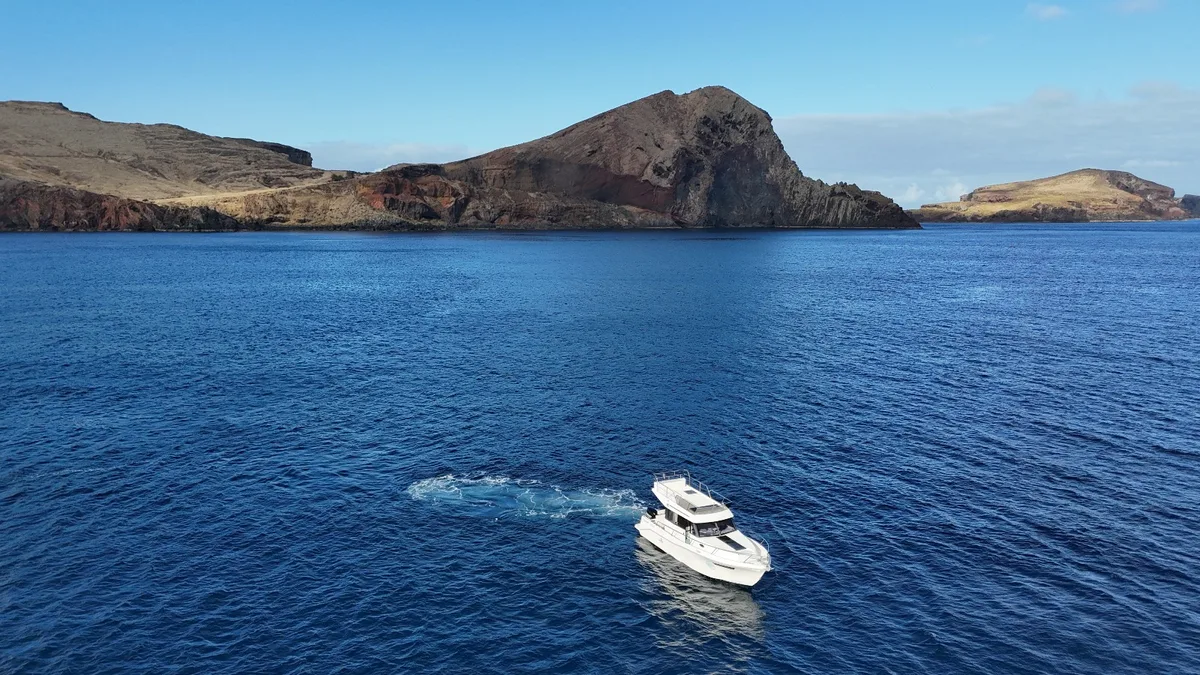
Madeira’s eastern coast offers a striking contrast to the island’s lush southern and northern shores. Dominated by rugged volcanic cliffs and a semi-arid landscape, this part of the island provides a dramatic setting against the deep, clear Atlantic waters. Exploring the Machico and Caniçal coastline by private boat invites guests to intimately experience a region where history, geology, and marine life blend into a memorable maritime adventure.
This coastline is rich in both natural beauty and historical significance. From Machico Bay — where Madeira’s first Portuguese settlers landed over six centuries ago — to the fishing village of Caniçal, with its maritime traditions, and on to the volcanic promontory of Ponta de São Lourenço, every mile reveals a story. Cruising these waters aboard a luxury yacht offers exclusive views of geological formations, opportunities to spot diverse marine species, and a chance to appreciate the serene charm of Madeira’s east coast.
The Storied Arrival at Machico Bay
Machico is often called the cradle of Madeira’s settlement. In 1419, Portuguese explorers João Gonçalves Zarco and Tristão Vaz Teixeira first touched land here, marking the start of Madeira’s rich Atlantic history. Approaching Machico Bay today by boat evokes a sense of this historic moment. The town nestles within a sheltered valley, embraced by steep hills that overlook calm, inviting waters.
From the sea, Machico’s distinctive golden beach is visible — one of the island’s few natural sandy shores, enhanced with imported Moroccan sand to improve its appeal. The imposing Forte de São João Baptista guards the bay’s entrance, a reminder of the town’s early strategic importance. The clear, tranquil waters provide a safe anchorage, making Machico Bay an ideal starting point for exploring the east coast.
Beyond its history, Machico offers visitors a taste of traditional Madeiran culture and cuisine in its charming cafés and restaurants ashore. A private yacht charter here balances relaxation with discovery, allowing guests to enjoy panoramic views of the bay and surrounding hills.
Caniçal: Maritime Heritage and Modern Conservation
Continuing east, the coastline changes dramatically near Caniçal, a village with deep maritime roots. Historically, Caniçal was at the heart of Madeira’s whaling industry—a now-defunct but once vital economic activity that shaped the community’s connection to the sea. The Madeira Whale Museum (Museu da Baleia da Madeira) preserves this heritage, serving as a centre for marine research, education, and conservation. Visitors can explore exhibits documenting the whaling history alongside ongoing efforts to protect marine ecosystems [1].
Sailing past Caniçal, the landscape becomes increasingly raw and volcanic. The cliffs showcase a palette of ochres, reds, and deep blacks, reflecting the island’s volcanic origins. This stark coastline, with rugged formations and sparse vegetation, contrasts sharply with Madeira’s verdant areas, lending the east coast a unique character.
The waters here support abundant marine life, frequented by cetaceans such as dolphins and various whale species. The proximity of deep oceanic waters to the shore creates an ideal habitat, making this stretch a prime location for marine wildlife observation.
A Rich Marine Ecosystem and Responsible Whale Watching
The seas along the Machico and Caniçal coastline are renowned for their biodiversity and are privileged spots for cetacean sightings year-round [2]. Dolphins, pilot whales, and occasionally larger baleen whales can be spotted, alongside sea turtles and other marine fauna. The deep ocean trench near the coast, with depths nearing 3,000 metres, fosters this rich environment.
Responsible wildlife observation is essential on any boat tour here. The Institute for Forests and Nature Conservation (IFCN) regulates cetacean watching to protect these animals [3]. Guidelines require vessels to keep a respectful distance of at least 50 metres and to allow marine creatures to approach on their own, minimising disturbance.
Guests should maintain realistic expectations: sightings cannot be guaranteed as these are free-ranging wild animals. Swimming with dolphins is strictly regulated and only allowed with authorised operators under specific conditions, reflecting the commitment to conservation and animal welfare.
Geological Marvels of Ponta de São Lourenço
At Madeira’s easternmost point lies the Ponta de São Lourenço peninsula, a remarkable geological formation shaped by volcanic activity and basalt flows. It is a Partial Nature Reserve, distinct from the rest of the island due to its treeless, arid landscape and striking rock formations [4]. The cliffs plunge dramatically into the Atlantic, offering breathtaking views from both land and sea.
From a private yacht, the rugged coastline of Ponta de São Lourenço is truly spectacular. Sunlight playing on the volcanic rocks reveals textures and colours rarely found elsewhere on Madeira. The reserve is also an important habitat for pelagic seabirds, which nest on the cliffs and soar above the ocean.
Visitors should note that disembarking is allowed only in designated areas to protect this fragile environment. Respecting these rules helps preserve the peninsula’s wild beauty and ecological balance for future generations.
Refreshing Waters at Cais do Sardinha
One of the most inviting stops along the east coast is Cais do Sardinha, a secluded cove near the tip of Ponta de São Lourenço. Accessible only by boat or a demanding hike along the Vereda da Ponta de São Lourenço trail (PR 8), this spot is famed for its exceptionally clear, calm waters [5].
Cais do Sardinha offers excellent swimming and snorkelling in a tranquil setting. Sea temperatures here usually range between 18⁰C in winter and 24⁰C in summer, providing pleasant conditions year-round [2]. Unlike developed beaches, it has no lifeguards or facilities, so visitors must exercise caution and be well prepared.
A private yacht charter enhances this experience, offering a secure and comfortable base. The crew can advise on the best swimming conditions and ensure guest safety while enjoying the pristine marine environment.
Preparing for Your East Coast Yacht Charter
Planning a trip along the Machico and Caniçal coastline requires some practical considerations for a smooth and enjoyable experience. Weather and sea conditions here can be more variable than on Madeira’s southern shores, with stronger winds often near Ponta de São Lourenço. It is advisable to consult your charter operator or skipper to adjust your itinerary based on daily forecasts and preferences.
Guests should bring sun protection such as hats and sunscreen, along with layers of comfortable clothing and a windbreaker, as temperatures on the water can feel cooler in the mornings or evenings. Those prone to seasickness should seek advice from healthcare professionals or pharmacists for appropriate remedies, since the seas around the eastern peninsula may sometimes be choppy.
Above all, flexibility and clear communication with your skipper will help ensure your charter adapts to conditions and delivers the best possible experience.
Operational Decisions and Guest Expectations
It is vital to distinguish between factual information about the Machico and Caniçal coastline and the operational choices made by your yacht charter operator. While the region is celebrated for its natural attractions and marine life, the specific itinerary, access to certain locations, and activities offered depend on the skipper’s assessment of safety, sea conditions, and regulations.
Visits to spots such as Cais do Sardinha and opportunities for swimming or snorkelling are at the skipper’s discretion, prioritising guest safety and environmental protection. Likewise, while whale watching is a highlight, sightings of specific species cannot be guaranteed due to the unpredictability of wildlife.
Understanding these distinctions helps set realistic expectations and ensures a rewarding, responsible yachting experience on Madeira’s east coast.
Sources
This guide uses the following official or specialist references. Confirm time-sensitive details at source before making travel plans.
Practical answers before you travel.
Can we guarantee seeing whales or dolphins on the east coast?
No, sightings cannot be guaranteed as these are wild animals living in their natural habitat. While the Machico and Caniçal coastline is known for frequent cetacean activity, the presence and behaviour of these animals remain unpredictable.
Is it possible to swim with dolphins in this area?
Swimming with dolphins is strictly regulated and permitted only under specific conditions with authorised operators. It is not a standard activity on all private yacht charters and follows conservation guidelines to protect the animals.
Can we disembark at Ponta de São Lourenço from the yacht?
Disembarkation is generally limited to designated areas such as Cais do Sardinha. Landing in restricted parts of the Partial Nature Reserve is prohibited to safeguard the delicate ecosystem and preserve the area’s natural beauty.
Are there facilities at Cais do Sardinha?
No, Cais do Sardinha lacks facilities and lifeguard surveillance. Visitors should exercise caution when swimming or snorkelling. A private yacht provides a safe and convenient base for enjoying these waters.
What is the typical water temperature along the east coast?
Sea temperatures typically range from around 18⁰C in winter to approximately 24⁰C in summer, offering generally mild conditions suitable for swimming throughout the year.
Will our boat trip definitely include Ponta de São Lourenço?
The final itinerary depends on the skipper’s evaluation of weather and sea conditions on the day of your charter. While Ponta de São Lourenço is a popular destination, safety considerations guide routes and stops.
What should guests bring for an east coast yacht trip?
Guests are advised to bring sun protection, comfortable clothing, a windbreaker, and any personal seasickness remedies if needed. Being prepared for variable weather and sea conditions enhances comfort and enjoyment.