
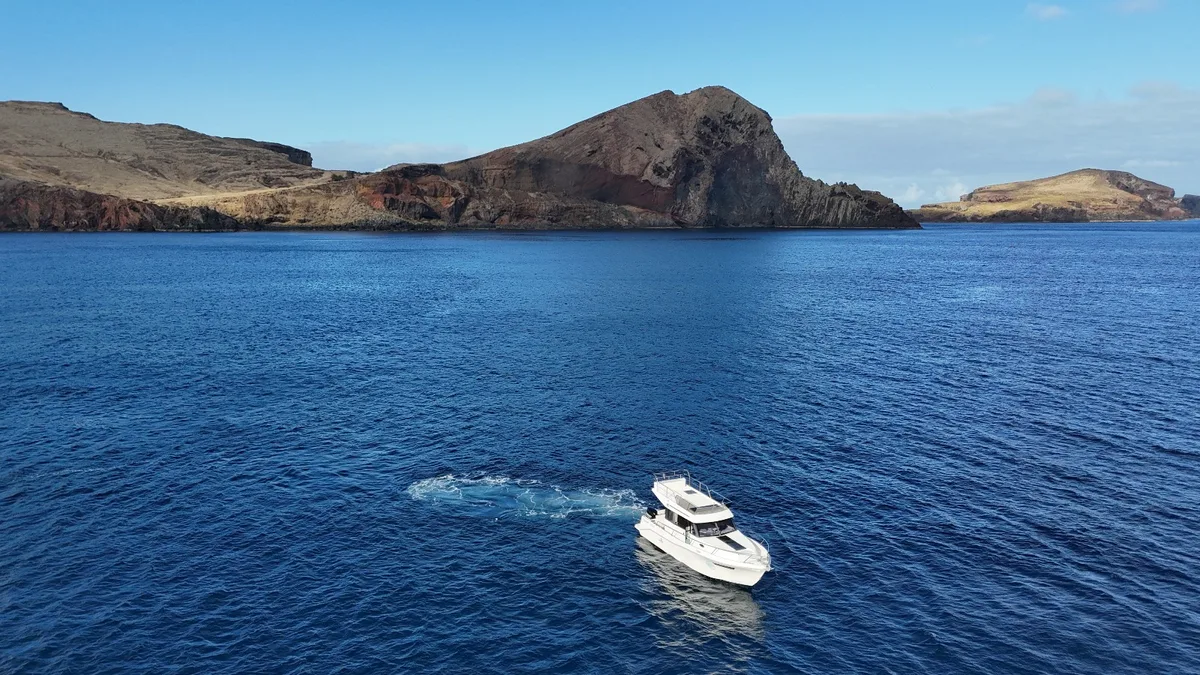
The archipelago of Madeira is a privileged location for marine life, situated in the deep waters of the Atlantic Ocean. With around 28 confirmed species of whales and dolphins recorded in these waters [1], the region is one of the most significant areas for marine observation in the Northern Hemisphere. The steep underwater drop-offs close to the coastline mean that deep-water species can often be found relatively close to shore, making the island an exceptional destination for marine enthusiasts.
For many guests on a private yacht charter, encountering dolphins in their natural habitat is a highlight of the journey. The waters around Madeira serve as both a feeding ground and a reproduction area for various species of the Odontoceti suborder, commonly known as toothed whales, which includes all dolphin species [2]. The nutrient-rich currents that flow past the islands support a complex food web, attracting the small fish and squid that form the primary diet of these marine predators.
While the prospect of seeing dolphins is exciting, it is essential to approach these encounters with respect and realistic expectations. As wild animals, their presence is never guaranteed, and their movements are dictated by natural factors such as food availability, ocean currents, and seasonal migrations.
The Marine Environment of the Archipelago
The unique topography of the ocean floor surrounding Madeira plays a crucial role in supporting its rich marine biodiversity. The islands are the visible peaks of massive underwater volcanoes that rise steeply from the abyssal plain, creating a phenomenon where deep oceanic waters are found just a short distance from the coast. Pelagic species that typically inhabit the open ocean are frequently observed within a few miles of the shoreline.
This proximity to deep water is particularly advantageous for dolphin watching, reducing the transit time required to reach the habitats of various species. The interaction between the prevailing ocean currents and the underwater landscape generates upwellings that bring cold, nutrient-dense water from the depths to the surface, fuelling the growth of phytoplankton and ultimately sustaining the diverse populations of dolphins found in the region.
Resident and Seasonal Dolphin Species
The diversity of dolphins in Madeira includes both resident species that can be observed year-round and seasonal visitors that pass through the archipelago during specific times of the year. This variety ensures that dolphin watching is a viable activity regardless of when you choose to visit, although the specific species you encounter may change.
The bottlenose dolphin, known locally as Roaz, is perhaps the most recognizable and frequently observed species in Madeira. These robust and highly intelligent animals are considered residents of the archipelago, meaning they can be seen throughout the year [1]. They often travel in small to medium-sized pods and are known for their acrobatic displays and curiosity towards boats. Bottlenose dolphins in Madeira are often observed feeding along the coastal shelf, and their playful interactions with the wake of passing vessels provide memorable moments for guests on board.
Despite their name, common dolphins have a more seasonal presence in Madeira. They are typically observed during the cooler months, particularly from winter through spring [1]. These dolphins are highly social and energetic, often forming large pods that can number in the hundreds. They are easily identifiable by the distinct hourglass pattern on their sides, featuring a yellowish-tan patch near the front and a grey patch towards the tail. When a large pod of common dolphins is on the move, the surface of the water can appear to boil with their rapid, synchronized swimming and frequent leaps.
The Atlantic spotted dolphin is a frequent summer visitor to the waters of Madeira. They usually arrive as the ocean temperatures begin to rise, typically from late spring through autumn [1]. As their name suggests, adults develop distinctive spots as they age, although calves are born without them. These dolphins are known for their playful nature and are often seen riding the bow waves of boats, providing spectacular viewing opportunities.
Understanding Dolphin Behaviour in the Wild
Observing dolphins in their natural environment provides an opportunity to witness a wide range of fascinating behaviours. These marine mammals are highly social creatures, and their interactions within the pod are complex and varied. When encountering a group of dolphins, you may observe them engaged in different activities, such as travelling, feeding, socializing, or resting.
Travelling dolphins typically move in a coordinated manner, surfacing regularly to breathe. Feeding behaviours can be more chaotic, with individuals diving repeatedly and sometimes working together to herd schools of fish towards the surface. Socializing often involves physical contact, vocalizations, and aerial displays such as breaching or tail-slapping. Recognizing these different behaviours helps the crew determine the appropriate way to approach and observe the animals without causing disturbance.
Planning Your Dolphin Watching Experience
When planning a private yacht charter with the hope of seeing dolphins, several factors should be considered to maximize your chances while ensuring a safe and comfortable trip. The expertise of your crew and the capabilities of your chosen vessel play a significant role in the overall experience.
Thanks to the presence of resident species like the bottlenose dolphin, dolphin watching in Madeira is a year-round activity. However, if you are interested in seeing specific seasonal species, you should plan your trip accordingly. Winter and spring are best for common dolphins, while summer and early autumn offer the highest chances of encountering Atlantic spotted dolphins.
Weather and Sea Conditions for Observation
The success of any marine observation depends heavily on the weather and sea conditions. Calm seas with minimal swell and wind provide the best visibility for spotting dolphins at a distance. Your skipper will continuously monitor the maritime weather forecasts and may suggest adjusting the itinerary or departure time to ensure the most favourable conditions.
Safety is the primary concern, and trips may be altered or rescheduled if the sea state is deemed unsuitable. Even on days when the weather appears fine from the shore, offshore conditions can be different, and the skipper's assessment is final.
What to Expect on Board a Private Charter
A private yacht charter offers a more intimate and flexible environment for dolphin watching compared to larger, crowded tour boats. Your crew will use their local knowledge and visual scanning techniques to locate pods. Once dolphins are spotted, the skipper will carefully manoeuvre the vessel to approach them safely, adhering to local regulations.
Guests should remain patient, as finding the animals can take time, and the encounter itself will be dictated by the dolphins' willingness to interact. The quiet environment of a private yacht allows guests to listen to the sounds of the dolphins breathing and communicating, adding an auditory dimension to the visual spectacle.
Responsible Observation and Conservation
The welfare of the marine life in Madeira is of paramount importance. The activity of observing cetaceans is governed by the Regional Legislative Decree No. 15/2013/M, which establishes a code of conduct to minimize disturbance to the animals [3]. This legal framework is designed to ensure that the growing interest in marine tourism does not negatively impact the delicate ecosystems of the archipelago.
These regulations dictate how vessels must approach dolphins, including maintaining a safe distance, limiting the speed of the boat, and restricting the number of vessels around a pod at any given time. Chasing or forcing an interaction with the animals is strictly prohibited. The approach must be gradual and parallel to the animals' course, allowing them the freedom to move away if they choose.
Madeira's waters host around 28 confirmed species of cetaceans, making it a globally recognized hotspot for marine biodiversity [1]. Dolphins are wild animals, and their presence in any specific area cannot be guaranteed, regardless of the season or the operator's experience. Observation activities are strictly regulated by the Institute for Forests and Nature Conservation (IFCN) to protect the animals and their habitat [3]. The exact route taken by your yacht will be determined by the skipper on the day, based on recent sightings, sea conditions, and weather forecasts. Swimming with dolphins is subject to strict regulations and requires specific authorizations; whether this activity is offered depends entirely on the operator's licences and the skipper's judgement of the situation on the day.
As a guest, you can contribute to responsible observation by following the crew's instructions, keeping noise levels down, and avoiding sudden movements that might startle the dolphins. The conservation of these species relies on the cooperation of both operators and visitors, working together to promote sustainable marine tourism.
Sources
This guide uses the following official or specialist references. Confirm time-sensitive details at source before making travel plans.
Practical answers before you travel.
Are dolphin sightings guaranteed on a private charter?
No. Dolphins are wild animals in their natural habitat, and their movements are unpredictable. While the crew will use their expertise to find them, sightings can never be guaranteed. The ocean is a vast environment, and the presence of marine life depends on numerous natural factors beyond human control.
What is the best month to see dolphins in Madeira?
Dolphins can be seen year-round. Bottlenose dolphins are residents, while common dolphins are more frequent in winter and spring, and Atlantic spotted dolphins are typically seen in summer and autumn. The ideal time depends on which specific species you are most interested in observing.
Can we swim with the dolphins?
Swimming with dolphins is heavily regulated in Madeira to protect the animals. It requires specific licences and is only permitted under strict conditions. You must check with your charter operator beforehand to see if they offer and are authorized for this activity, as it is not a standard inclusion on all trips.
How close will the boat get to the dolphins?
Vessels must adhere to strict approach guidelines set by the IFCN, which include maintaining a minimum safe distance to avoid disturbing the animals. The dolphins may choose to approach the boat closer on their own terms, but the skipper will never force an interaction or chase the pod.
What happens if the sea is rough?
Your skipper will assess the sea conditions prior to departure. If the weather or sea state is deemed unsafe or unsuitable for observation, the trip may be altered, delayed, or rescheduled. Safety is always the primary concern, and the skipper's decision regarding maritime conditions is final.
Do I need to take medication for seasickness?
If you are prone to motion sickness, it is advisable to prepare in advance. Please consult with a healthcare professional or pharmacist regarding suitable over-the-counter medications before your trip. The crew cannot dispense medical advice or provide specific pharmaceutical products on board.