
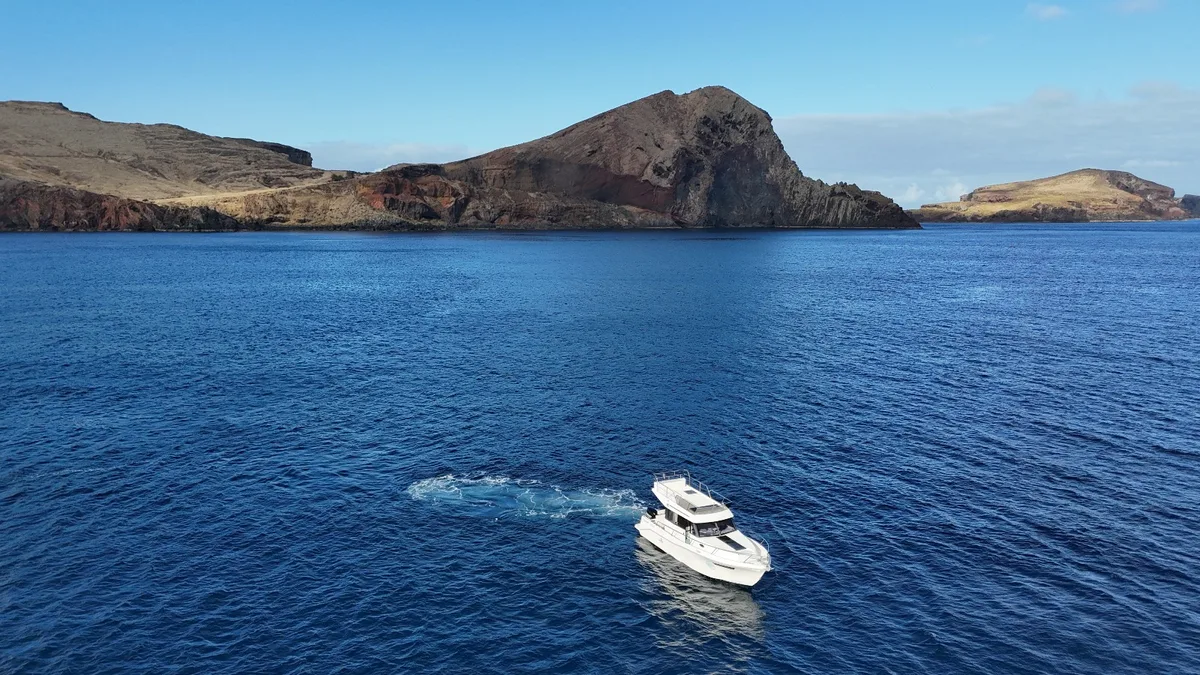
The archipelago of Madeira is renowned for its rich marine biodiversity and numerous cetacean species [2]. Among the most fascinating visitors to these waters is the Bryde's whale (Balaenoptera edeni), a baleen whale that occasionally graces the Madeiran coastline. Known locally by the traditional name "Finbeque" [1], this magnificent creature presents a thrilling sight for those fortunate enough to encounter it during a private yacht charter. Understanding its seasonality and identifying features enriches observation and appreciation of Madeira's marine ecosystem.
Encountering a Bryde's whale in its natural habitat is a privilege that requires patience, respect, and a keen eye. Unlike some resident species that can be seen year-round, the presence of Bryde's whales in Madeira is seasonal and occasional. This unpredictability adds an element of excitement to any maritime excursion, as each journey holds the potential for a rare and memorable sighting. However, it is crucial to approach these encounters with a strong commitment to responsible wildlife observation, ensuring that the animals are not disturbed in their natural environment.
For guests embarking on a private yacht charter, knowing what to look for and when to expect these gentle giants can significantly enrich the journey. The waters surrounding Madeira, characterized by their impressive depths and nutrient-rich currents, provide an ideal feeding ground for Bryde's whales during specific times of the year. By familiarizing yourself with their physical characteristics and behavioral patterns, you can become an active participant in the observation process, working alongside your experienced skipper to spot these elusive marine mammals.
Understanding the Seasonality of Bryde's Whales in Madeira
The occurrence of Bryde's whales in the waters of Madeira is closely tied to the changing seasons and the availability of food sources. While the archipelago is home to several resident cetacean species, the Bryde's whale is considered a seasonal visitor. According to official records, the first documented sighting of this species in the Madeiran archipelago occurred in 2004 [1], highlighting its relatively recent recognition in the region's marine catalog.
The most favorable period for observing Bryde's whales in Madeira spans from June to October [1]. During these warmer months, the ocean conditions and the abundance of small schooling fish and planktonic crustaceans, such as krill, attract these whales to the area. The warming of the surface waters creates an inviting environment for the prey species, which in turn draws the larger predators. It is important to note that their presence is not guaranteed, as they are highly mobile and their movements are dictated by the distribution of their prey. Therefore, while the summer and early autumn months offer the highest probability of sightings, guests should maintain realistic expectations and appreciate the wild and unpredictable nature of these encounters.
Key Identification Features of the Bryde's Whale
Identifying a Bryde's whale at sea requires careful observation of specific physical characteristics. Adult Bryde's whales can reach impressive lengths of up to 13 meters and weigh as much as 18,000 kilograms [1]. Despite their substantial size, they possess a sleek and streamlined body, typical of rorqual whales. Their coloration is generally a dark, smoky grey on the dorsal side, transitioning to a lighter shade on the ventral surface.
The most distinctive feature used to identify a Bryde's whale is the presence of three longitudinal ridges on its rostrum, or the upper part of its head [1]. This unique characteristic sets it apart from similar species, such as the Sei whale (Balaenoptera borealis), which only has a single central ridge. When a Bryde's whale surfaces to breathe, these three ridges are often visible, providing a clear diagnostic marker for experienced observers and marine biologists.
Another behavioral trait that aids in identification is the way the Bryde's whale arches its caudal peduncle (the area just before the tail flukes) when preparing for a deep dive [1]. This pronounced arching is a characteristic movement that can help distinguish it from other baleen whales in the region. However, unlike some other species, Bryde's whales rarely raise their tail flukes above the surface when diving.
Diet and Feeding Behavior in the Atlantic
The diet of the Bryde's whale in Madeiran waters consists primarily of small schooling fish, such as sardines, anchovies, and mackerel. They are also known to consume small planktonic crustaceans, including krill, when available [1]. Their feeding strategy often involves lunging through schools of prey with their mouths wide open, expanding their throat pleats to engulf large volumes of water and food. The water is then expelled through their baleen plates, which act as a filter, trapping the prey inside.
Observing a Bryde's whale feeding is a spectacular sight, often accompanied by the presence of seabirds and other marine predators drawn to the abundance of fish. However, it is essential to remember that feeding areas are critical habitats for these animals, and any observation must be conducted with the utmost care to avoid disrupting their natural behavior. The presence of boats can sometimes scatter the prey or cause the whale to abandon its feeding efforts, which is why strict adherence to observation guidelines is paramount.
Responsible Observation and Legal Regulations
The observation of cetaceans in Madeira is strictly regulated to ensure the protection and well-being of the animals. The Regional Legislative Decree No. 15/2013/M establishes comprehensive guidelines that all vessels, including private yacht charters, must follow [3]. These regulations are designed to minimize the impact of human presence on marine wildlife and promote sustainable tourism practices. The archipelago takes its role as a sanctuary for marine life very seriously, and these laws are enforced to maintain the delicate balance of the ecosystem.
When encountering a Bryde's whale, or any other cetacean, vessels are required to maintain a minimum distance of 50 meters [3]. The approach must be gradual, and the vessel's speed must be reduced to less than 12 knots when within 500 meters of the animals, and less than 8 knots within 300 meters [3]. The approach should always be made from behind and parallel to the animal's course, leaving a clear 180-degree field ahead for the whale to navigate freely.
It is strictly prohibited to pursue, touch, or feed marine mammals. Furthermore, swimming with whales is not permitted under any circumstances in Madeira [3]. The maximum observation time allowed per vessel is 10 minutes, ensuring that the animals are not subjected to prolonged stress or disturbance [3]. By adhering to these regulations, guests can enjoy a responsible and ethical wildlife encounter while contributing to the conservation of these magnificent creatures.
The Role of the Skipper in Whale Observation
During a private yacht charter, the skipper plays a crucial role in ensuring both the safety of the passengers and the well-being of the marine life. Their extensive knowledge of the local waters, weather patterns, and animal behavior is invaluable. The skipper is responsible for navigating the vessel in accordance with the strict observation guidelines, ensuring that the approach is slow, parallel, and maintains the required distance. They also communicate with other vessels and spotters on land to locate areas of activity, maximizing the chances of a sighting while minimizing the impact on the animals. It is important to trust the skipper's judgment, as their decisions are always made with the best interests of the guests and the environment in mind.
Public Facts vs. Operational Decisions
When planning a private yacht charter with the hope of observing Bryde's whales, it is important to distinguish between established public facts and the operational decisions made by the charter company and the skipper. The seasonality, physical characteristics, and legal protections of the Bryde's whale are well-documented scientific and legal facts. However, the actual itinerary of your boat trip, the specific routes taken, and the duration of the journey are operational decisions that depend on various dynamic factors.
The skipper holds the ultimate responsibility for the safety of the vessel and its passengers. Therefore, decisions regarding navigation are heavily influenced by real-time weather conditions, sea state, and maritime forecasts provided by authorities such as the Portuguese Institute for Sea and Atmosphere (IPMA). While the skipper will make every effort to navigate towards areas where sightings are more likely, they cannot guarantee encounters with specific species. The unpredictability of wildlife and the dynamic nature of the ocean mean that every trip is unique, and flexibility is key to enjoying the experience.
Sources
This guide uses the following official or specialist references. Confirm time-sensitive details at source before making travel plans.
Practical answers before you travel.
When is the best time to see Bryde's whales in Madeira?
The most favorable period for observing Bryde's whales in Madeira is between June and October [1]. During these months, the ocean conditions and the availability of prey attract these seasonal visitors to the archipelago. However, sightings are never guaranteed due to the wild and unpredictable nature of the animals.
How can I distinguish a Bryde's whale from other species?
The most reliable way to identify a Bryde's whale is by observing the three longitudinal ridges on its rostrum (the upper part of its head) [1]. This feature distinguishes it from similar species like the Sei whale, which only has one ridge. Additionally, Bryde's whales often arch their caudal peduncle significantly when diving [1].
Can I swim with Bryde's whales during a yacht charter?
No, swimming with whales is strictly prohibited by law in Madeira [3]. The Regional Legislative Decree No. 15/2013/M regulates the observation of marine vertebrates and forbids swimming with whales to ensure their protection and minimize human disturbance [3].
How close can the yacht get to the whales?
According to local regulations, vessels must maintain a minimum distance of 50 meters from whales and dolphins [3]. The approach must be careful and parallel to the animals, and the vessel's speed must be significantly reduced to avoid causing stress or altering their natural behavior [3].
What happens if the weather is bad on the day of the charter?
The safety of the passengers and the vessel is the top priority. If the weather or sea conditions are deemed unsafe by the skipper, based on official forecasts, the itinerary may be altered, or the trip may be rescheduled or canceled. These operational decisions are made to ensure a secure and enjoyable experience.
Are sightings of Bryde's whales guaranteed?
No, sightings of Bryde's whales, or any other cetacean, cannot be guaranteed. They are wild animals in their natural habitat, and their presence depends on various factors, including food availability and oceanographic conditions. A yacht charter offers the opportunity for observation, but nature dictates the outcome.